
The Rausser College of Natural Resources Honors Program is designed to support undergraduate students interested in developing, executing, and evaluating a year-long independent research project under the guidance of a faculty mentor.
Students who successfully complete the Honors Program will earn recognition at graduation and will also receive a notation of Honors in their major on their diploma. The Honors Symposium, held once each semester, gives all Honors students the opportunity to present their research to fellow students, faculty, Deans, friends, and family.
Students are responsible for creating their research within the limitations that may exist due to public health guidelines. As is the case with any research project, the student should work with the faculty to determine the possibility for remote, lab, or field research as they apply to the specific project.
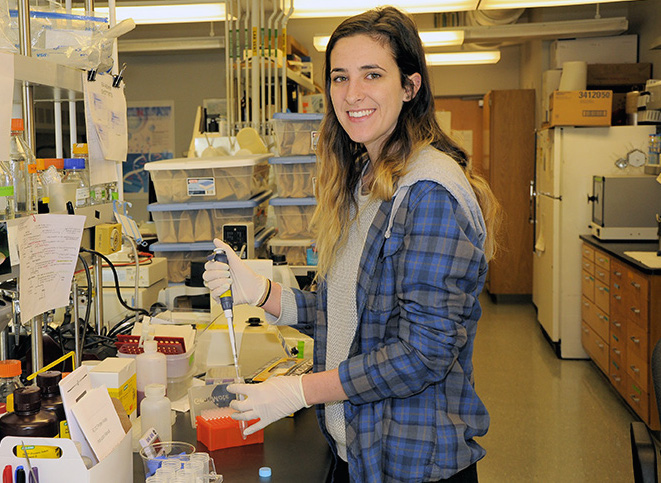
Plant and microbial biology student Mary Ahern. Photo: Jim Block
Important Dates:
- Enrollment for Summer 2024 - Fall 2024
- Cohort Application opens: 1/8/2024
- Deadline to enroll: 6/21/2024 by 11:59 PM
- Enrollment for Fall 2024 - Spring 2025 cohort
- Application opens: 8/28/2024
- Deadline to enroll: 9/13/2024 by 11:59 PM
Eligibility
- Possess a minimum overall UC GPA of 3.6 or higher.
- Students who were enrolled at UCB in Spring 2020 may apply to the Honors Program, and complete the program, with a 3.55 GPA or higher
- Have completed a minimum of 60-semester units (attained junior or senior status).
- Junior transfer students must have completed at least one semester at UC Berkeley with a 3.6 GPA.
- Have no more than 2 incomplete grades on your academic record.
- Must be on campus for two semesters of consecutive research.
- Must be declared in their RCNR major by the semester in which they wish to begin their first semester of Honors research.
- Research format and structure will vary greatly by subject area. Research in the biological sciences may be more likely to take place in the lab or the field, research in the social sciences may be more likely to be focused on qualitative data or literature analysis. These are generalizations, but all forms of research are eligible! Work with your faculty mentor to determine the best research format for your project
Program Requirements
- Complete 8 units of letter-graded departmental honors courses with your faculty mentor and earn a grade of B or better each semester. Students enroll in a four-unit H196 course for two consecutive semesters. Environmental Sciences students will follow the enrollment steps outlined in their Senior Research Seminar and then will be enrolled directly into ESPM H175A and H175L in the Fall, and ESPM H175B and H175L if they meet the GPA threshold to qualify for Honors.
- Maintain a minimum overall UC GPA of 3.6 or better through graduation (3.55 for those attending in Spring 2020). This will be strictly enforced with the exception of approved petitions for health or similar circumstances in situations where the GPA is close but below the threshold.
- Give an oral presentation at the Rausser College Honors Symposium. Up to 10 slides in a PowerPoint presentation must be sent ahead of time to the honors coordinator.
- Write an honors research thesis and submit copies to your Faculty Sponsor/Research Mentor. The thesis format will conform to the expectations for submission of a "publishable" paper to the relevant research discipline.
How to Apply
- Environmental Sciences students do not apply directly through the Honors Research Program. You will work with the Senior Research Seminar in Environmental Sciences instructor to complete the requirements to either enroll in ESPM 175A and 175L in the Fall and ESPM 175B and 175L in the spring or the Honors versions of the courses (H175A, H175B, H175L) depending on your cumulative GPA. ES Honors students will present at their own Research Symposium and submit their thesis document to their ESPM H175B instructor accordingly. ES students do not need to apply to the Honors Program separately from their Senior Thesis enrollment process
- Submit your research proposal (300 words minimum) and Rausser College Honors Program Enrollment Form. For resources for writing your proposal, follow the suggestions from the Office of Undergraduate Research & Scholarships and VCResearch.
- Identify a faculty mentor to serve as your research mentor. If you choose to work with a faculty member outside of Rausser College, you must also identify a faculty sponsor in your home department at Rausser. If your research mentor is a Rausser faculty member, you do not need to find an additional sponsor. Environmental Sciences students are required to obtain the signature of an ESPM 175 instructor in addition to their research mentor (if they are different).
- Submit your Honors Program Enrollment form to the Rausser College Honors Program at honors.rcnr@berkeley.edu by the end of the third week of instruction of the semester in which you plan to enroll in the Honors Program. The Honors Program Coordinator will enroll students directly in the course after eligibility has been verified.
- Email honors.rcnr@berkeley.edu if you have any additional questions.
Honors Info Session
See the honors info session below for more information about the program and applying. Originally delivered on September 3rd, 2020.
SPUR and the Honors Program
Rausser College encourages students applying to the Honors Program to also apply for funding through the Sponsored Projects for Undergraduate Research (SPUR) program. Honors students may submit a Student-Initiated Proposal and request up to $2,000 in funding through SPUR. The deadline to submit a Student-Initiated Proposal is typically a month earlier than the Honors Program enrollment deadline, so please plan accordingly.
Double Majors
If you wish to participate in the Honors Program in one major, the guidelines described above are exactly the same.
If you wish to pursue Honors in both majors, you must meet the full requirements of the program for both majors. You will need two research projects with two research mentors, and a faculty sponsor in each department. You must take 8 units of H196 with each sponsor and write two publishable papers. This kind of endeavor will almost certainly take two years to accomplish, so careful planning is a must.
Simultaneous Degree Students
Simultaneous degree students are welcome to pursue Honors in their Rausser College major, with all the same requirements and opportunities.
Archive of Past Participants Projects & Fall and Spring Symposia
Interested in seeing what research projects previous participants have completed? You may review a list of past participants and their project titles by clicking the link above. To see sample Honors Proposals and Theses, view our new digital library of examples here.
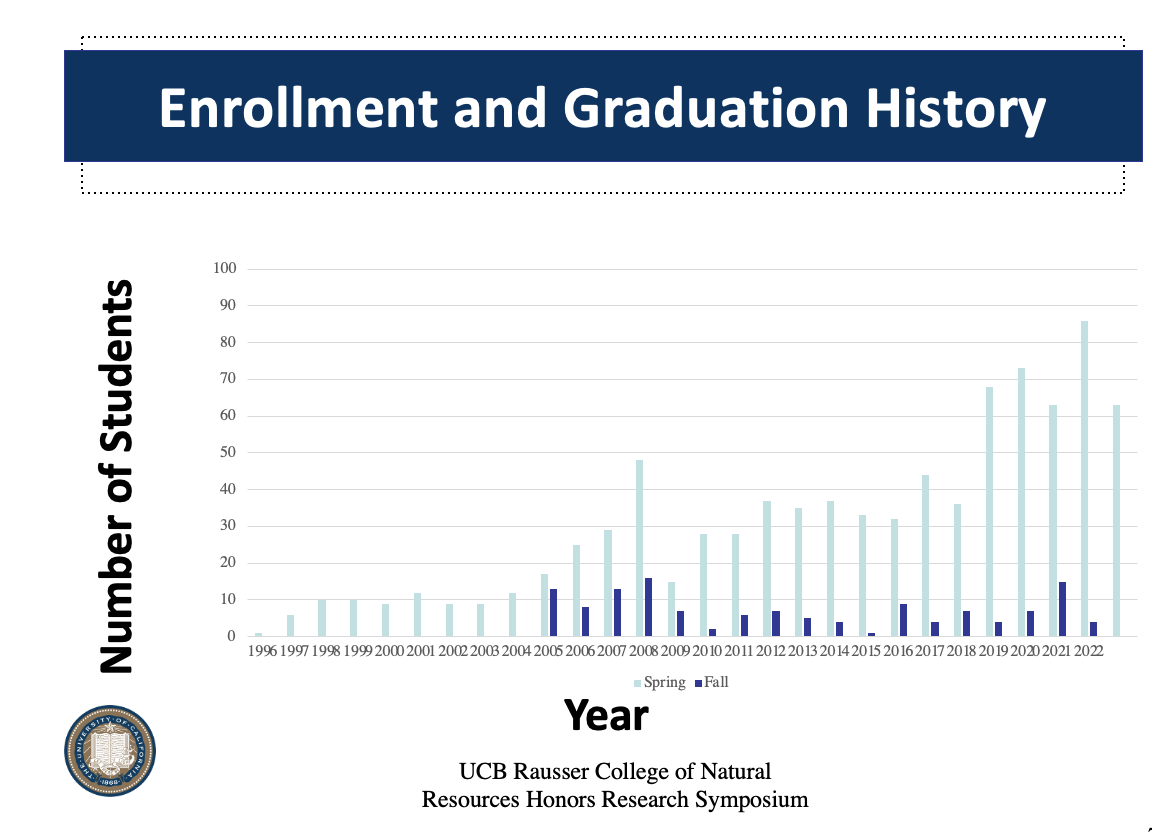
Since the start of the Rausser College Honors Program in 1996, a total of 1,087 students have graduated with HONORS from Rausser as of Spring 2023.
A playlist of student research is available here. The Fall 2020 recorded symposium is available here. At the following links, you can see Day 1 and Day 2 of the Spring 2021 symposium. The Fall 2021 recorded symposium is available here.
The Honors Melis Medal
All honors students present their thesis during the Honors symposium in the Social Sciences and in the Biological Sciences and are eligible to be considered for receiving a medal named in the honor of the Honors Program founder Professor Tasios Melis. In his name, Rausser CNR awards the Melis Medal to the best student presentation delivered during each day of the culminating event.
In Fall 2023 the Melis Medalists are